
You want to be a merchant in late Ming China. But from where do you get your abacus?
Now that I have finished my dissertation, I finally have more time to sit and write, and revisit some of my older projects. One that I have been thinking about a lot lately is the abacus or the Chinese suanpan 算盤 (also known as zhusuan 珠算). Not so much about how it worked — although that is worthy of its own writing — but more about how it was made and sold.
We read a lot about the rise of this bead-based calculator in everyday life and its ubiquity already by the late Ming period, but we rarely say anything about how people acquired it. Were they just made for individuals or were they widely available in shops? To me, it’s a fascinating question, and one that doesn’t seem to have an obvious answer.
A Few Notable Things
On the one hand, it’s a simple instrument to make; so, it’s entirely possible that these instruments were produced by run of the mill carpenters. Most abaci are made from a few pieces of wood, which form a rectangle. Chinese abaci, in contrast to say the Russian type, contain a bar in the center which separates the upper beads from the lower beads. Inside the frame and cutting through the central bar are circular rods where the maker attaches the five beads on the bottom and the two on the top. [Note: There are variations in whether the upper half contains one or two beads and whether the bottom contains four or five beads. The principle is the same.]
There is evidence to support the thesis that abacus-making was widely available by even village carpenters. We know that abacus making was a part of the traditional sources of knowledge for carpenters. The construction of the abacus was added to the items mentioned in the carpentry manual Luban jing in the late Ming. But the material may have been drawn from earlier sources.
“(An abacus) is 1 chi 2 cun long and 4 cun 2 fen wide. The frame is 6 fen thick and 9 fen wide, and topped with a “bowl bottom” moulding. The upper part has two balls and measures 1 cun 1 fen. In the lower part, five balls are fitted. It measures 3 fen 1 cun. Length and width are chosen according to the size of the balls.” Source: Ruiteenbeek 268-270
一尺二寸長,四寸二分大,框六分厚九分大起碗底線上二子一寸一分下下五子三寸一分長短大小看子而做
The instructions could easily have been transmitted through these carpentry traditions.
But visual sources about the abacus point to a more interesting context. They suggest that the abacus might have been specialized in certain areas of manufacture. These visuals actually place it in the context of traveling merchants. The National Palace Museum has multiple paintings attributed to Song-period artists which depict knick-knack travelers carrying abaci for sale. We find the abaci hanging off the side of the carts that are overflowing with all sorts of products. The Yuan-period painting by Wang Zhenpeng called Qiankun yidan similarly depicts a peddler displaying his wares. On the far left side of the image, there is an abacus among the set of toys and objects.
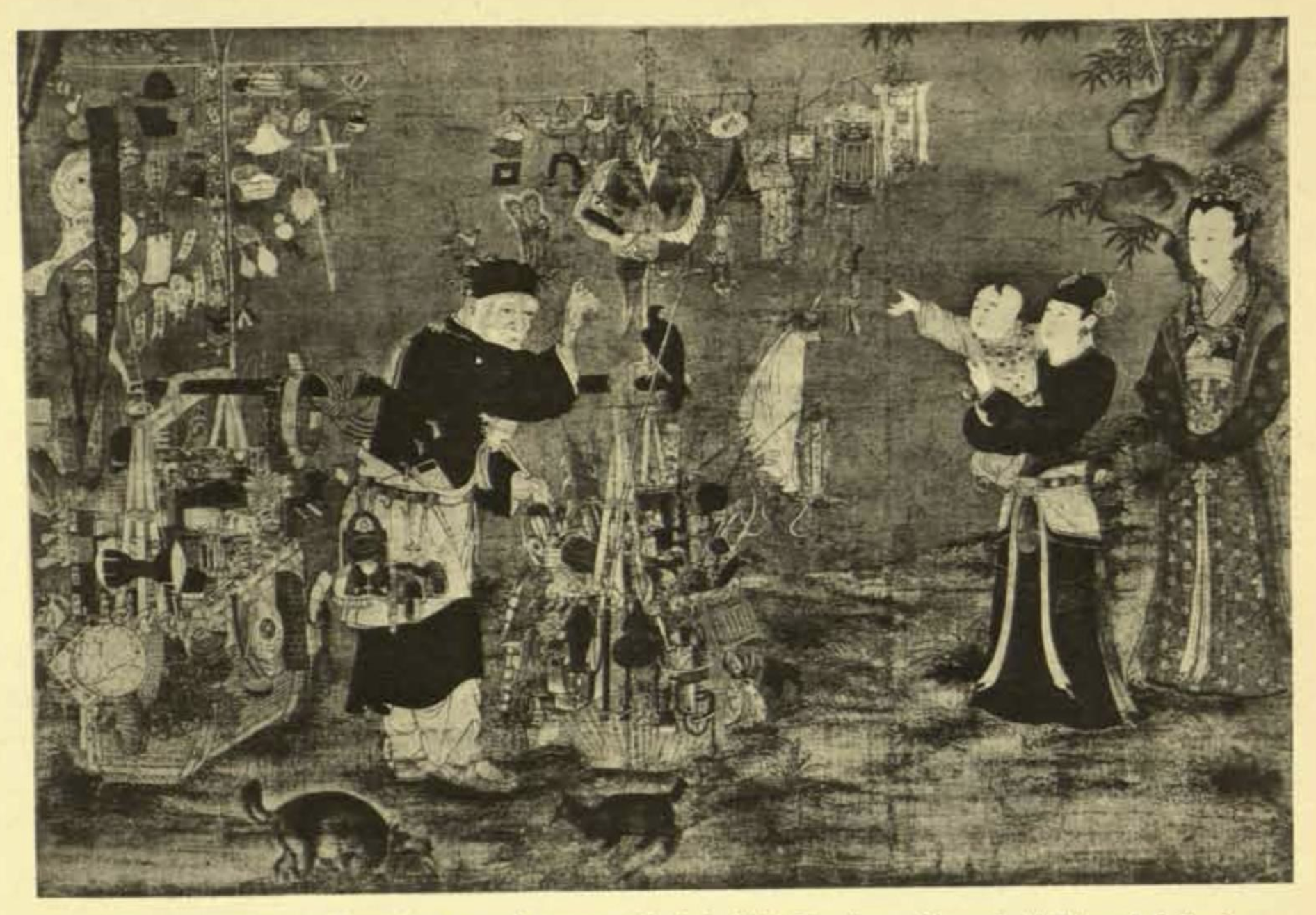
Plate 47 in Osvald Siren, Chinese Painting, Vol. 6. The left-most carriage contains the abacus. It is one of the objects behind the drum. There are other versions of the image which make it somewhat clearer than this example.
Surviving Abaci
These cases are fascinating because they are not just about everyday markets, but about the kinds of products that were brought from distant places or particular situations. We see books, ceramics, birds, and specialty foods included in these images, a regular smorgasbord of things. Although some of these objects in theory could be produced locally, for connoisseurs interested in these products, like we read in lists of things or in the works of Gao Lian (16th century) and Wen Zhenheng (1585–1645), many of the objects were linked to the specific locations that produced them.
Some abaci were obviously ordinary. There is one abacus that has been found in the tomb of Lu Weizhen 盧維禎 (1543-1610), who served as a minister in the Board of Revenue and the Board of Works. The abacus dates to the Wanli reign. The abacus is more like the soroban found in Japan today, with a single bead for the upper drawer and with beads that were shaped like hexagons. What is most interesting about it from the perspective of making, however, is that the abacus is constructed entirely of wood. The frame is wood and beads were made of wood. Even though Lu was an elite bureaucrat, this abacus does not appear to be a luxury product. (For more: see 王文径, 明户、工二部侍郎卢维桢墓, 东南文化 1989 (03) 215-222)
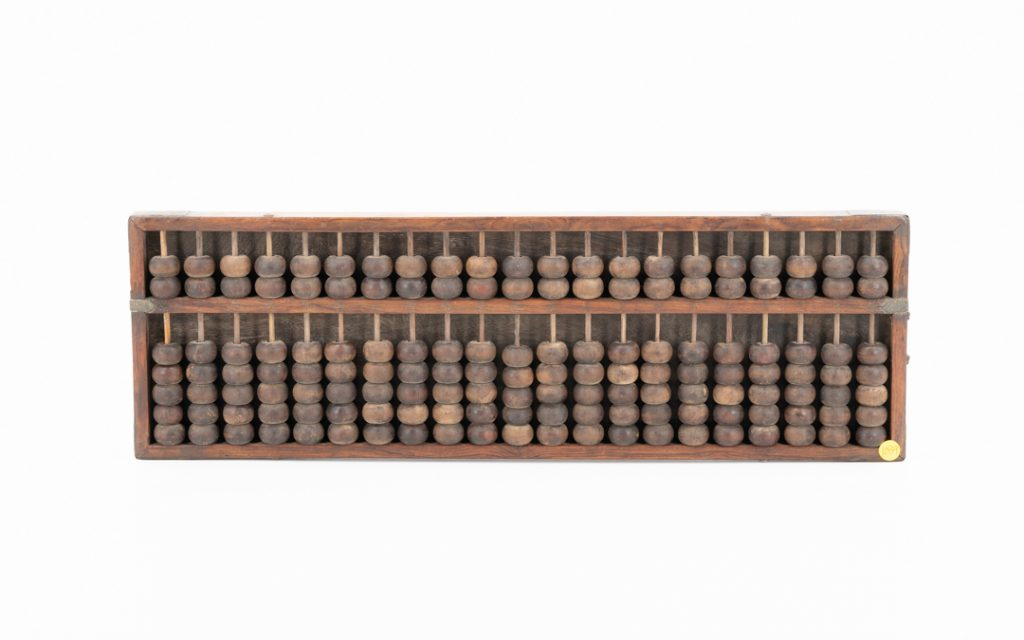
Chinese Abacus (suanpan), ca. late 16th century, (the late Ming Dynasty), North China, Hefei Zimuyuan Museum
Wood, though, could differentiate these tools from everyday items. For instance, there is another suanpan attributed to the late Ming which is currently held in the Hefei Zimuyuan Museum. The abacus is made from several types of wood. The frame and back plate are made from pear woods, common woods that could also be used in woodblock carving; but the beads are made from nanmu 楠木. This wood was prized, and it had elite connotations. The palace collected this wood as tribute, and connoisseurs used this wood for high-quality furniture. (Miller, Fir and Empire, 144; Berliner et al., Beyond the Screen, 68)
There are other Ming-period abaci that also point to this luxury market for calculating tools. The National Museum of China has a Ming-era abacus that has a wood frame but carved ivory beads instead of wooden beads. Even though this was a small part of the abacus, this easily places the abacus in the realm of elite and luxury products.
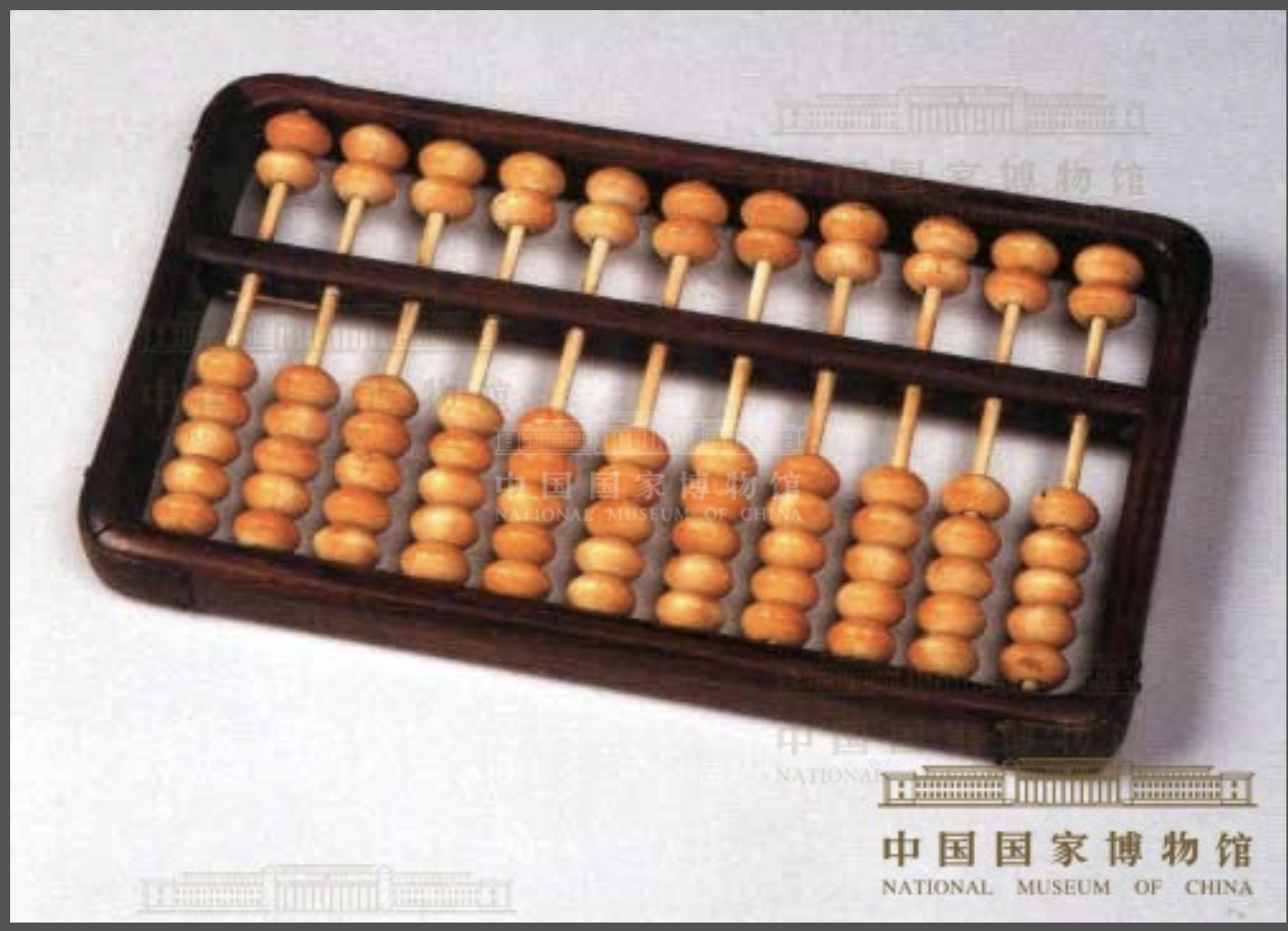
Ivory Bead Abacus, Ming, National Museum of China
More luxury abaci can be found in the private collections and abaci museums in China, including the Shaanxi Yulin Abacus Museum, the Shanghai Abacus Museum, the Linhai Abacus Museum, and the Nantong Abacus Museum. Some of the more sumptuous examples are made out of carved ivory, previous woods, and use gems for beads.
These objects indicate that abacus making could be a part of luxury craft too. Some of the abaci must have been a part of the general carpentry training, but other products that used these costly raw materials would have been a part of more specialist trade. If this is the case, then abacus making could have led to special craftsmen or individuals who produced quality calculators.
Abacus and Local Makers
There is some additional evidence that supports this conclusion that speciality crafts in these tools started to emerge in the late Ming. Wu Jing, who wrote the earliest treatise on the abacus, was from the area around Hangzhou. During the Chongzhen period, we find direct references to the abacus being made in this area. The local gazetteer for Suzhou lists the abacus among the wood products made by its carpenters. [Note: Another popular work on the abacus though Xu Xinlu’s volume was published from Fujian.]
One case that is somewhat curious especially for its seeming omission is Huizhou or Xiuning. The most famous book on the abacus was published by Cheng Dawei who was from Xin’an, the area that gave rise to an important center of salt merchants. But Huizhou was also well-known for its wood carving traditions. The late Ming printing industry regarded Huizhou carvers to be the most talented carvers for woodblock printing. And, local carvers in the area also produced other types of delicate wood carvings in bamboo and other woods. Although Cheng Dawei and later writers made the abacus a necessary tool for merchant practice, I have not yet seen any pre-Qing references to abacus-making in the area.
Similarly, I have not yet found particular references for northern merchants. The merchants of Shanxi and Shaanxi also became famous in the late Ming period, although they became more influential in the Qing. They too promoted the use of the abacus for apprentices and the children of merchants. But while the abacus that is held in Anhui interestingly enough is said to be from North China and is attributed to the late Ming, I have not found much material on the manufacturing of abaci from the region.
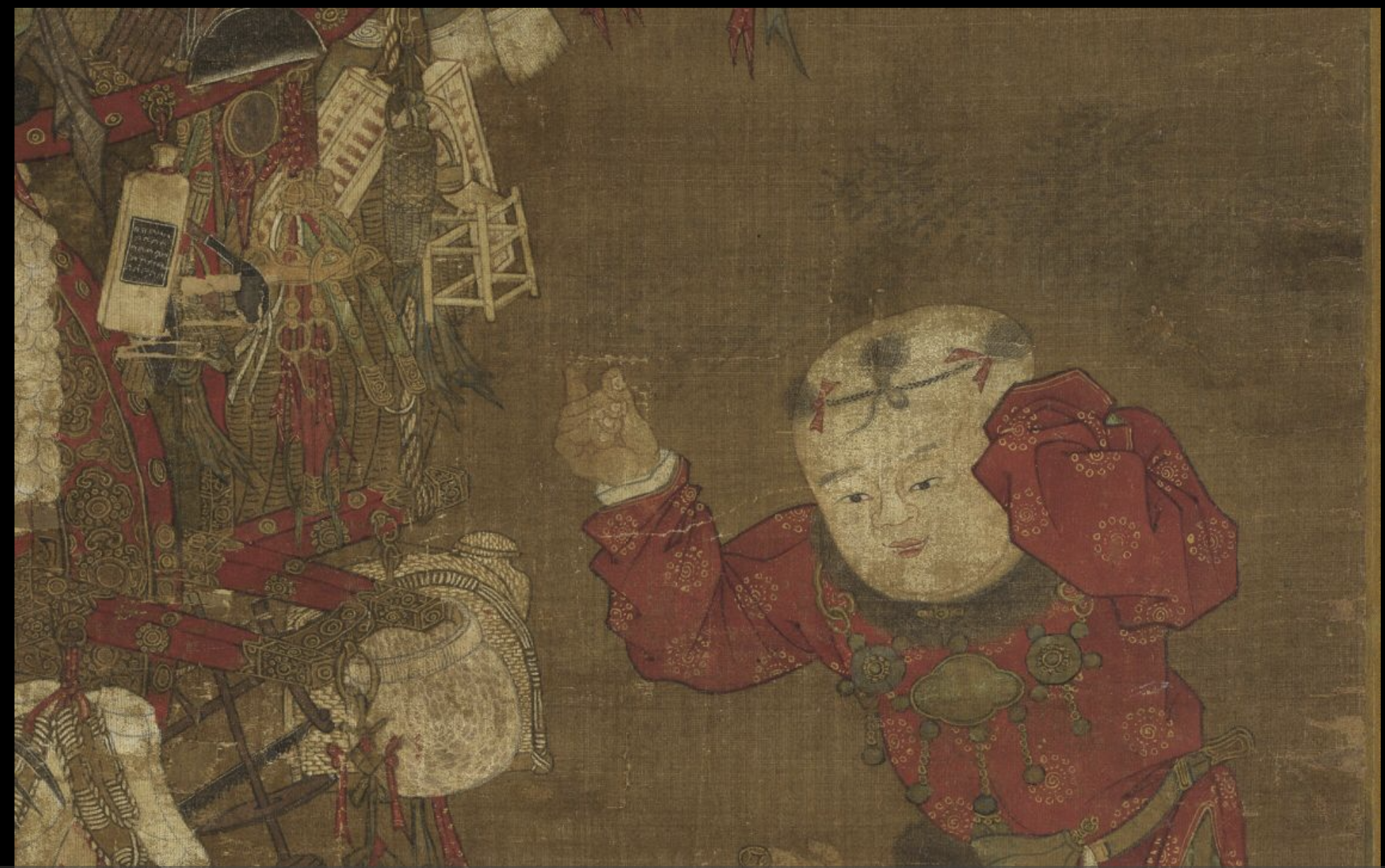
There are two abaci hanging from the back side of the knick-knack peddler’s cart in this genre painting from the Song. “The Knick-Knack Peddler” 貨郎圖, attributed to Su Hanchen 蘇漢臣, National Palace Museum, Taipei, 故畫00009000000
During the Qing dynasty, there are clearer references to a mature trade in regional abaci. There were some places and families that had brand recognition in abacus construction. Handbooks for merchants in the Qing also provide more detail not only on the close connection between abacus learning and commerce but also how certain regions produced abaci as a local product.
But the sources from the Ming remain frustratingly scant about where and how people acquired these tools. I suspect there is much more we can learn about this.
More Research
There is a cottage industry about late Ming market expansion and commercialization, books that even use the abacus as the metaphor for the period, but for all that discussion, we know very little about how these things were actually made and just how merchants got the tools. Did they request them from small workshops? Did they buy from markets or traveling salesmen? Where there particular shops that sold them? Were they family heirlooms? Since the physical evidence points to clear social distinctions in the design of an abacus and access to certain raw materials, what can we say about the emerging distinctions that were connected to the object and different social classes?
Today, the abacus remains very popular — which is firstly a consequence of twentieth-century educational reforms that explicitly incorporated abacus training in elementary math education; and secondly, the interest in computing and its predecessors. So, there are plenty of popular stories about it. But they are quite repetitive. Those narratives often talk about its history and appearance in the Song and Yuan, and they almost always mention Cheng Dawei. Some works interested in the physical evidence do mention the late Ming tomb discoveries cited above or some of the more impressive abaci. I did a quick scan in the volumes of the Zhongguo jindai shougong ye shi ziliao 中国近代手工业史资料 (Historical Materials on China’s Modern Handicraft Industries, dated but still a good source on guilds and artisans), but despite its focus on the different layers of industries, it doesn’t have much to say about the abacus.
For an object that so often stands in for early modern China’s commercialization, I find it ironic that we know so little about the actual economy of the abacus itself.